
Martial Arts Influence
Practical fighting, not sport or performance karate
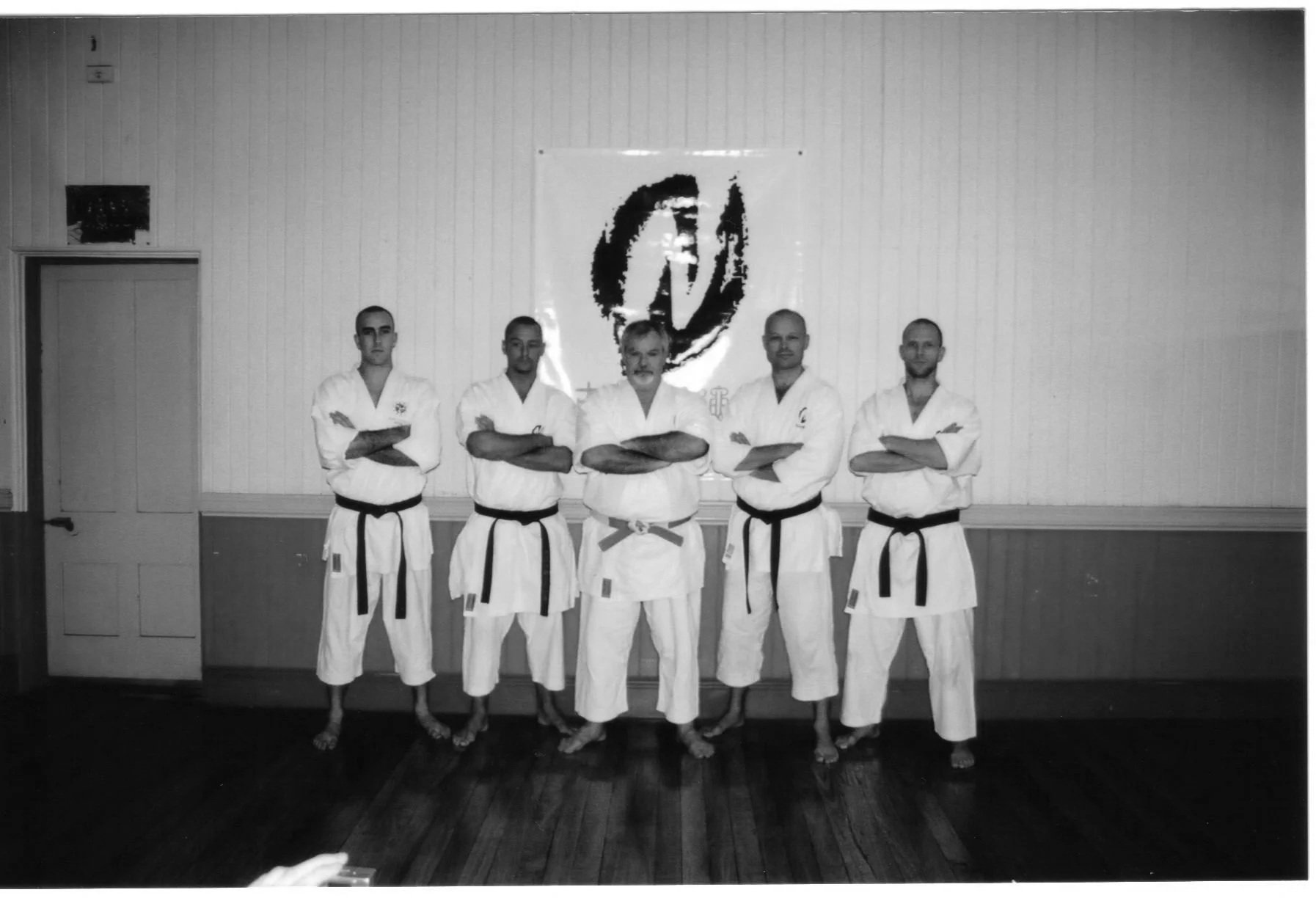
Koryū Uchinadi Kenpō-jutsu (KU)
Between 1999 and 2005, David undertook intensive study in Koryū Uchinadi Kenpō-jutsu (KU) under Hanshi Patrick McCarthy, during a formative period when KU was explicitly focused on practical civilian self-defence rather than sport or performance karate. During this time, he was awarded 3rd Degree Black Belt and the teaching title of Renshi, recognising not seniority, but demonstrated competence in applied understanding, teaching method, and instructional responsibility. He also attained 1st Degree Black Belt in Kobudō, reflecting integrated study of classical Okinawan weapons as extensions of body mechanics, distance management, and combative principles.
Within KU, the title Renshi denotes a practitioner entrusted with the accurate transmission of method, including the ability to translate kata from mnemonic reference into functional, pressure-tested application, manage learning environments safely, and uphold KU’s non-sport, non-performance ethos. This responsibility reinforced David’s enduring focus on simplicity, adaptability, and robustness under stress.
Click on the buttons below for more information.
Modern Arnis
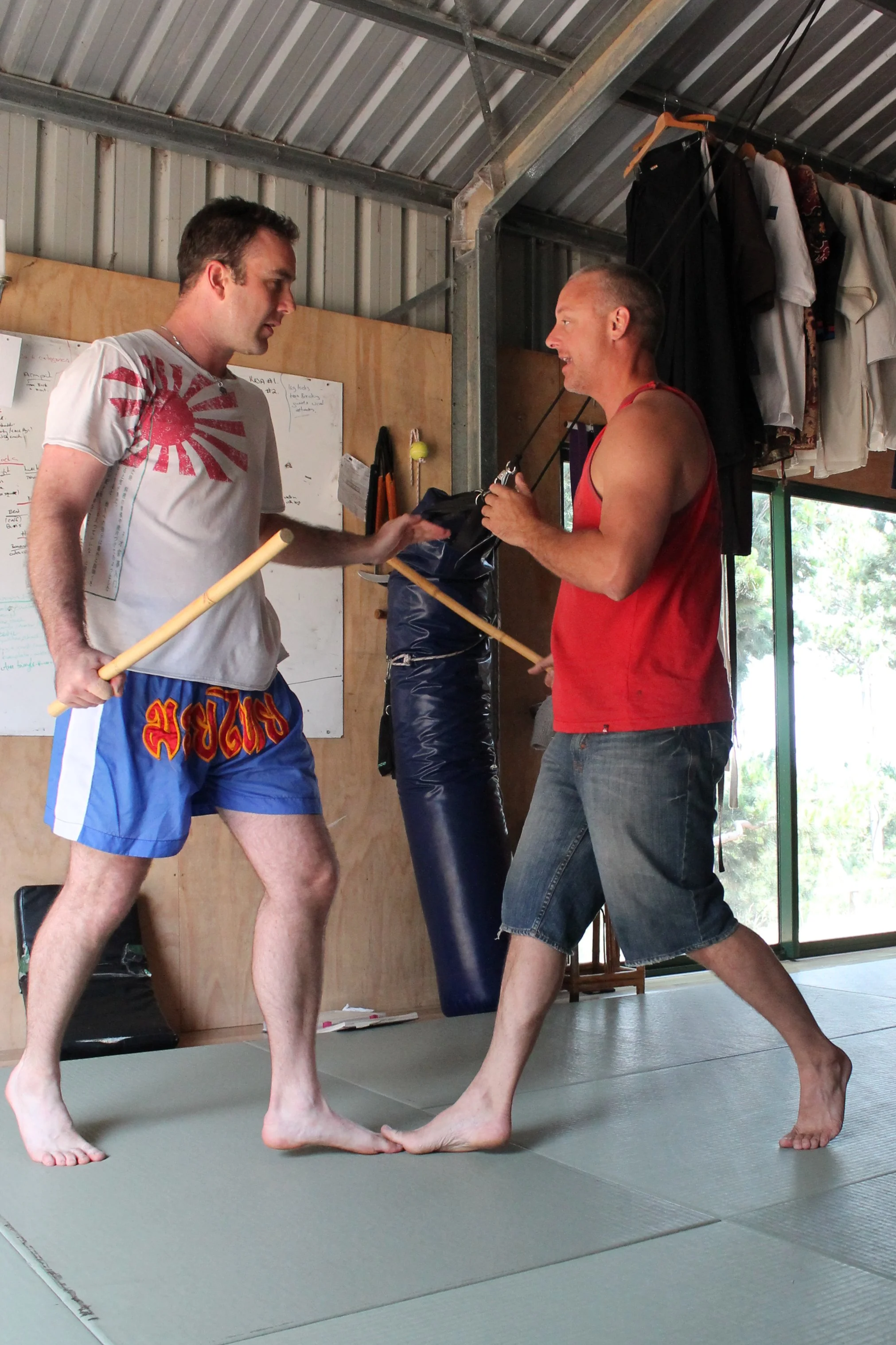
DAVE Training in NZ with Kurt
David also undertook long-term study and practice in Modern Arnis, primarily alongside Kurt Graham, extending his focus on practical, weapon-aware self-defence systems. Modern Arnis, founded by Remy Presas and further developed in the Philippines by Grandmaster Ernesto Presas, emphasises weapons-first learning, seamless transition between armed and unarmed contexts, and adaptive problem-solving under pressure. Through this work, David engaged with principles associated with Ernesto Presas’ Philippine-based teachings, particularly the integration of stick, blade, and empty-hand methods, tactical angling, limb control, and intent-driven application.
Training under Kurt Graham was grounded in the Modern Arnis tradition, a Filipino martial system developed to preserve the effectiveness of indigenous fighting methods while ensuring their relevance in contemporary contexts. Modern Arnis is distinguished by its weapons-first pedagogy, reflecting the reality that Filipino martial culture evolved around bladed and impact weapons long before unarmed systems were formalised. This approach treats weapons not as specialised tools, but as extensions of human movement, intent, and problem solving, ensuring skills remain transferable across contexts.
Instruction emphasised timing, angling, distance management, and intent, rather than reliance on fixed techniques or predetermined responses. Training consistently addressed the fluid transition between armed and unarmed engagement, recognising that real encounters are dynamic, unpredictable, and often involve environmental or improvised tools. Effectiveness was measured not by technical appearance or conformity to form, but by the practitioner’s ability to maintain function under pressure, disruption, and uncertainty.
A defining feature of this tradition is its insistence on pressure-tested learning. Techniques were subjected to resistance, fatigue, and contextual constraint, ensuring that skills remained robust when fine motor control diminished. This emphasis stands in contrast to sportive or performance-based martial models, where success is shaped by rulesets rather than consequence.
In 2015, while training and teaching in New Zealand, David da Silva was awarded 5th Degree Black Belt in Modern Arnis, recognising not only technical proficiency, but sustained commitment to the system’s functional ethos, teaching responsibility, and applied effectiveness.
These experiences reinforced a consistent philosophy that has shaped David da Silva’s later work across coaching, education, and high-performance systems: skill has value only insofar as it survives contact with pressure and reality. This principle underpins his rejection of cosmetic technique and over-structured learning, in favour of adaptability, robustness, and performance under real-world constraints.
Friendship in Budō
In many activities we meet people. In budō, we meet ourselves—and through that process, we meet others in a way that is rarely possible anywhere else.
Because of this, budō friendships often develop quietly. They are built over years of training rather than moments of excitement. A bow at the start of class, the rhythm of repeated drills, the understanding that both partners are there to help each other improve—these small rituals create a bond grounded in respect.
Budō also teaches humility. No matter how long someone has trained, there is always more to learn. This shared understanding removes many of the barriers that normally separate people. Age, background, and profession become less important than attitude and commitment. What matters most is how you show up on the training floor.
Recently, I was reminded of how deep these connections can run. My sempai, Conrad, passed away. In budō, the word sempai carries a particular meaning. It is not simply someone who trained longer. A sempai is someone who walks slightly ahead on the path—someone who shows you what is possible through their effort, their attitude, and their willingness to help others learn.
Conrad was that kind of training partner. The lessons he gave were rarely delivered as speeches. They came through training—through patience, through correction, through the quiet expectation that you keep improving. In budō, people like this shape your understanding of the art without ever needing to claim authority.
His passing is a reminder that the true inheritance of budō is not just techniques or kata. It is the relationships formed through years of shared practice. The time spent learning, failing, adjusting, and trying again—side by side on the training floor—creates bonds that endure long after the session ends.
Friendship in budō is therefore not simply social connection. It is a partnership in growth. Training partners challenge each other, support each other, and occasionally frustrate each other—but always with the understanding that progress is mutual. When one person improves, the other benefits. Over time, these relationships extend beyond the dojo. People who have trained together through difficulty and discipline often remain connected for life. The respect developed through shared practice becomes a foundation for genuine friendship.
Perhaps this is why budō traditions have endured for centuries. Techniques evolve, teachers change, and organisations come and go. Yet the human connection formed through training remains constant.
There are many activities where we can compete, perform, or achieve recognition. But there are very few places where we can learn so much about ourselves while helping others do the same. In budō, friendship is not an accident. It is a natural outcome of honest practice.
And sometimes, when someone we trained beside is gone, we realise that the greatest lessons they left behind were never written in manuals or hidden in a kata.
They were written in the way they treated others on the training floor—and in the friendships that remain long after they are gone.
Miss you Geezer
Quisque iaculis facilisis lacinia. Mauris euismod pellentesque tellus sit amet mollis.