
Koryu Uchinadi ‘KU’ Advanced Kata
Practical fighting, not sport or performance karate
In its original Okinawan context, kata was developed for practical self-defence, not sport fighting or regulated competition. It addressed civilian violence—sudden, close-range, chaotic encounters where there are no rules, no referees, and no time to “set up” techniques. As such, kata prioritised pre-emptive action, positional control, balance disruption, and rapid incapacitation, rather than prolonged exchanges or symmetrical duelling.
Koryū Uchinadi, as systematised by Patrick McCarthy, makes this self-defence purpose explicit. Kata sequences are analysed through the lens of Habitual Acts of Physical Violence (HAPV): grabs, swings, clinches, headlocks, and ambush attacks that typify real interpersonal conflict. Techniques are applied at clinching distance, integrating strikes, limb control, takedowns, and environmental awareness—elements largely absent from sport-based karate formats.
Unlike sport fighting, where success depends on timing within agreed rulesets, kata-derived self-defence focuses on initiative, simplicity, and stress tolerance. Movements are designed to function when fine motor skills deteriorate, when space is limited, and when the defender may be off-balance or surprised.
In this way, Koryū Uchinadi restores kata to its original role: a functional self-protection methodology, grounded in realism rather than aesthetics, and concerned with surviving violence—not winning contests.
Naihanchi
Close-range fighting, structure, clinch principles.
Matsumura Bassi
Bassai is interpreted as “to extract from a fortress” or “to break through,” describing overcoming force, structure, or confinement rather than dramatic power display.
Aragaki Seisan
Direct linear pressure and short stepping.
Aragaki Sochin
Compact posture and rooted stance (often misrepresented later as a deep “stance kata”)
Aragaki Niseishi
Emphasising close-range engagement and tactical repositioning.
Aragaki Unshu
Emphasis on continuous, adaptive movement rather than fixed technique.
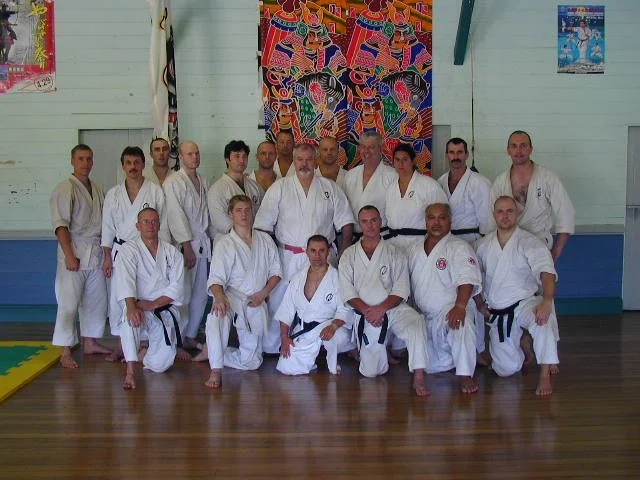
David at Koryū Uchinadi Sō Honbu Dōjō - international headquarters of Koryū Uchinadi Kenpō-jutsu (KU). Located at the Australian College of Natural Medicine (ACNM) - from the late 20th century through the early 2000s.
Quisque iaculis facilisis lacinia. Mauris euismod pellentesque tellus sit amet mollis.