
Koryu Uchinadi ‘KU’ White Crane Kata
Practical fighting, not sport or performance karate
White Crane kata preserve the internal, anatomical, and neurological layer of Okinawan self-defence. They refine how structure (Naihanchi) is used, ensuring karate remains jutsu—a practical method for surviving real violence—not a sport or spectacle.
Principle-based, not choreography-based
Breath-timed issuing of force
Tactile sensitivity and redirection
Structural disruption rather than force-on-force
Used to teach internal mechanics, breath, and nervous system control
Always paired with two-person drills and resistance
Studied only after foundational structure is established (e.g. Naihanchi)
Happōren (Eight-Step Linking)
Multi-directional close-range engagement
Continuous limb control while striking
Recovery of balance under pressure
Hakutsuru (White Crane form – variant transmissions)
Whipping, spine-driven power
Vulnerability targeting (neck, throat, clavicle)
Soft–hard transitions under contact
Practical Fighting Emphasis - KU White Crane kata address Habitual Acts of Physical Violence (HAPV):
Grabs, clinches, head control
Swinging punches and shoves
Sudden ambush at conversational distance
Not Sport. Not Public Kata
Hakutsuru -
KU White Crane kata are advanced reference models, preserved to transmit the internal, neurological, and anatomical dimension of Okinawan self-defence. They are not taught for rank, competition, or aesthetics—but to ensure karate remains a functional method for surviving close-range violence.
Happoren
A bridge between structure (Naihanchi) and adaptability (Hakutsuru)
Nepai
Interruption and control— principles survive pressure, resistance, and unpredictability.
Ryushan
Tomari-te lineages and was never intended for sportive exchange; its structure reflects civilian self-defence at close rang
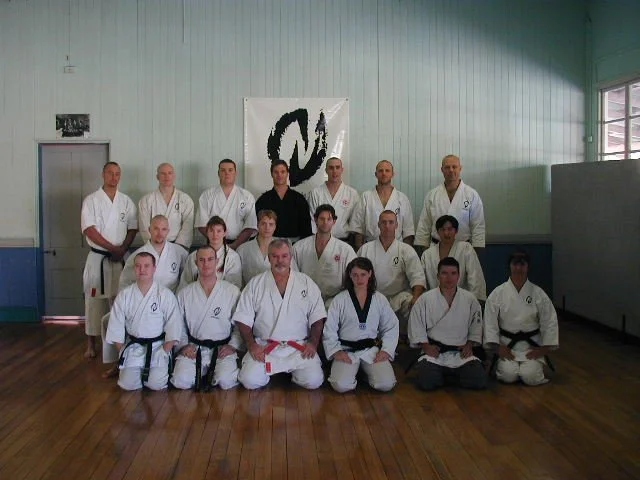
David at Koryū Uchinadi Sō Honbu Dōjō - international headquarters of Koryū Uchinadi Kenpō-jutsu (KU). Located at the Australian College of Natural Medicine (ACNM) - from the late 20th century through the early 2000s.
Quisque iaculis facilisis lacinia. Mauris euismod pellentesque tellus sit amet mollis.